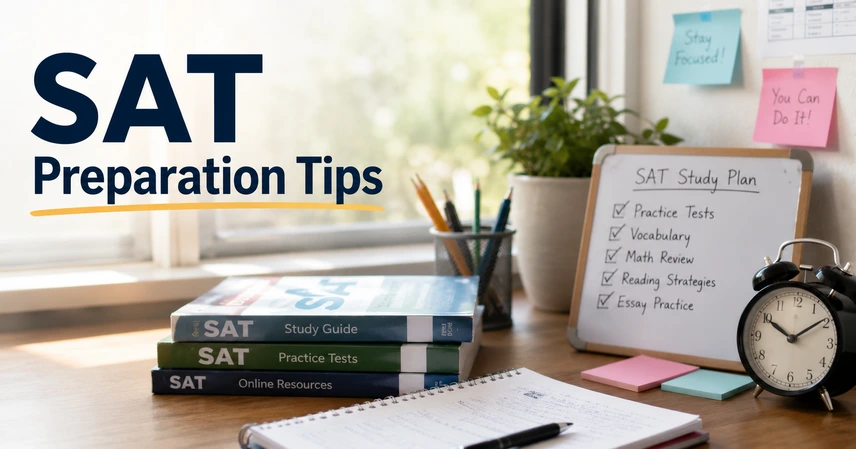
Preparing for the SAT can feel overwhelming, especially when you see advertisements promoting costly tutoring programs that promise dramatic score improvements. While professional tutoring can be helpful for some students, it is far from the only path to success. Thousands of students earn excellent SAT scores every year through consistent self-study, smart planning, and the effective use of free or affordable learning resources.
The SAT measures skills you’ve developed over many years rather than memorization alone. Because of this, improving your score requires understanding the exam format, strengthening fundamental reading, writing, and math skills, and practicing under realistic testing conditions. The good news is that these are all areas you can improve without spending thousands of dollars on private tutors.
Read More : 8 Study Tips Every College Student Needs to Improve Grades and Avoid Burnout
This guide shares sixteen practical SAT preparation tips that help students study more efficiently, avoid common mistakes, and maximize their potential without relying on expensive tutoring services.
Why Smart SAT Preparation Matters
Many students believe improving their SAT score depends on studying longer hours. In reality, successful preparation focuses on studying more effectively rather than simply studying more. A structured preparation plan helps you:
- Build confidence before test day.
- Identify strengths and weaknesses.
- Reduce test anxiety.
- Improve time management.
- Develop better problem-solving skills.
- Increase your chances of achieving your target score.
Consistency is often more important than intensity. Studying one hour each day over several months usually produces better results than trying to learn everything during the final weeks before the exam.
1. Understand the SAT Format
Before opening a practice book, take time to understand how the SAT is organized. Knowing what to expect allows you to study with purpose instead of guessing what may appear on the exam. The digital SAT consists of two main are Reading, Writing and Math.
Each section measures skills commonly taught throughout high school, including reading comprehension, grammar, algebra, data analysis, advanced mathematics, and problem-solving. Become familiar with:
- Question types
- Section timing
- Adaptive testing format
- Calculator policies
- Scoring system
Understanding the exam structure reduces uncertainty and allows you to develop effective strategies for each section.
2. Set a Realistic Target Score
Every student has different academic goals.Instead of trying to achieve a perfect score simply because it sounds impressive, establish a realistic target based on the colleges or scholarship programs you’re interested in.Once you determine your goal, compare it with your current practice test score. For example:
- Current practice score: 1180
- Target score: 1350
- Improvement needed: 170 points
Breaking your goal into smaller milestones makes preparation less overwhelming and allows you to monitor your progress throughout your study plan.A realistic goal also helps maintain motivation because each improvement becomes measurable.
3. Create a Consistent Study Schedule
One of the biggest mistakes students make is studying only when they feel motivated. Motivation naturally changes from day to day, but a consistent schedule builds long-term progress. Design a weekly study plan that fits around your schoolwork and extracurricular activities. For example:
| Day | Focus Area |
| Monday | Reading and Writing |
| Tuesday | Math Practice |
| Wednesday | Vocabulary and Grammar |
| Thursday | Mixed Practice Questions |
| Friday | Review Mistakes |
| Saturday | Full Practice Sections |
| Sunday | Light Review and Rest |
Studying consistently for 45 to 90 minutes several times a week is generally more productive than occasional marathon study sessions.
4. Take a Full-Length Practice Test Early
One of the smartest ways to begin preparing is by taking a complete practice test before starting intensive study. This first score becomes your baseline. It reveals:
- Strong subjects
- Weak areas
- Time management issues
- Common mistakes
- Question types that require additional practice
Try to simulate real testing conditions by:
- Completing the exam without interruptions.
- Timing each section accurately.
- Avoiding unnecessary breaks.
- Working independently without checking answers.
A realistic practice test provides valuable information that helps you study more efficiently in the weeks ahead.
5. Focus on Your Weakest Subjects
Many students repeatedly practice questions they already know because it feels rewarding.However, significant score improvements usually come from strengthening weaker areas. After reviewing your practice tests, identify patterns such as:
- Algebra mistakes
- Grammar errors
- Reading comprehension challenges
- Vocabulary misunderstandings
- Time management problems
Allocate more study time to these areas while continuing to review your stronger subjects. Improving weak skills often produces greater score gains than repeatedly practicing concepts you’ve already mastered.
6. Learn the Test Instead of Memorizing Answers
The SAT is designed to evaluate reasoning and problem-solving abilities rather than memorized facts. Instead of simply remembering correct answers from practice tests, ask yourself:
- Why was this answer correct?
- Why were the other options incorrect?
- Which concept was being tested?
- How could this question be presented differently?
Understanding the reasoning behind each question helps you apply the same thinking process to unfamiliar problems on test day. Developing conceptual understanding is far more valuable than memorizing specific questions.
7. Use High-Quality Practice Materials
Not every SAT resource provides the same level of quality. Some unofficial practice books contain unrealistic questions or outdated content that may not accurately reflect the actual exam. Choose study materials that closely match the current digital SAT format. Good resources typically include:
- Realistic practice questions.
- Detailed answer explanations.
- Full-length practice tests.
- Performance tracking.
- Updated question formats.
Using reliable materials helps ensure that your preparation reflects the skills and question styles you’ll encounter on the actual exam. Quality matters much more than the number of practice questions you complete.
Read More : 14 Common College Application Mistakes That Can Cost You Admission in the US
8. Review Every Mistake Carefully
One of the most effective learning strategies is reviewing mistakes immediately after completing practice questions.Simply checking whether an answer is right or wrong isn’t enough. Instead, analyze every incorrect response by asking:
- Did I misunderstand the question?
- Did I rush because of poor time management?
- Did I forget a formula?
- Did I overlook an important detail?
- Was I uncertain between two answer choices?
Consider keeping an error journal where you record:
- The question type.
- The correct solution.
- Why your answer was incorrect.
- What you’ll do differently next time.
Over time, this habit helps eliminate repeated mistakes and strengthens your understanding of tested concepts. Students who consistently learn from their errors often improve more quickly than those who simply complete additional practice questions.
9. Build Strong Reading Habits
The Reading and Writing section measures more than grammar and vocabulary. It also evaluates your ability to understand, analyze, and interpret written passages efficiently. Developing a daily reading habit can gradually improve these skills. Read a variety of materials, such as news articles, science publications, historical essays, and literary works. Exposure to different writing styles helps you become more comfortable with the types of passages you may encounter on the SAT. As you read, practice identifying:
- The author’s main idea.
- Supporting evidence.
- Tone and purpose.
- Relationships between ideas.
- Context clues for unfamiliar words.
Reading actively instead of passively strengthens both comprehension and critical thinking.
10. Strengthen Your Math Fundamentals
Many SAT math questions build on core concepts rather than advanced calculations. A solid understanding of foundational topics can significantly improve your performance. Focus on reviewing:
- Algebraic equations.
- Functions.
- Ratios and proportions.
- Percentages.
- Linear equations.
- Data interpretation.
- Basic geometry.
- Introductory trigonometry.
If you struggle with a particular concept, revisit the underlying principles before attempting more difficult problems. Understanding why a formula works is often more valuable than simply memorizing it. Consistent practice with a variety of question types will help you recognize patterns and solve problems more confidently.
11. Improve Your Time Management Skills
Knowing the material is only part of earning a strong SAT score. You must also manage your time effectively during the exam. Many students spend too long on difficult questions and then rush through easier ones. Practice these strategies:
- Answer easier questions first.
- Skip difficult questions temporarily and return later if time allows.
- Monitor your pace throughout each section.
- Avoid spending several minutes on a single problem.
- Practice with timed sessions regularly.
The more familiar you become with the exam’s pacing, the more confident you’ll feel on test day.
12. Learn to Eliminate Wrong Answers
You don’t always need to identify the correct answer immediately. Often, eliminating obviously incorrect choices greatly increases your chances of selecting the right response. Look for answer choices that:
- Contradict the passage.
- Contain extreme language such as “always” or “never.”
- Include information not supported by the question.
- Misinterpret the author’s main point.
Developing this skill improves accuracy, especially when you’re unsure of the correct answer.
13. Take Care of Your Physical and Mental Health
Effective SAT preparation isn’t just about studying. Your physical and mental well-being have a direct impact on concentration, memory, and problem-solving. Healthy habits include:
Get Enough Sleep
Aim for seven to nine hours of quality sleep each night. Sleep supports memory consolidation and improves focus.
Eat Nutritious Meals
Balanced meals provide steady energy during study sessions and on test day.
Exercise Regularly
Even moderate physical activity can improve mood, reduce stress, and increase mental alertness.
Manage Stress
Practice relaxation techniques such as deep breathing, mindfulness, or short walks to avoid burnout during your preparation. Remember that studying while exhausted is often far less productive than studying with a well-rested mind.
14. Simulate Real Test Conditions
As your exam date approaches, complete several full-length practice tests under realistic conditions. Try to recreate the actual testing experience by:
- Following official timing limits.
- Working in a quiet environment.
- Avoiding phones and other distractions.
- Taking scheduled breaks only.
- Using the same type of calculator you plan to use on test day.
These practice sessions build endurance and reduce anxiety because the real exam feels more familiar. They also help you identify any remaining weaknesses before test day.
15. Develop a Positive Test-Day Mindset
Confidence plays an important role in academic performance.Instead of worrying about achieving a perfect score, focus on doing your best with the preparation you’ve completed. Before the exam:
- Prepare your materials the night before.
- Get adequate sleep.
- Eat a balanced breakfast.
- Arrive early if testing in person.
- Read each question carefully before answering.
If you encounter a difficult question, don’t panic. Stay calm, move forward when necessary, and return to challenging questions if time permits. A positive mindset helps you think more clearly under pressure.
16. Stay Consistent and Trust the Process
Improving your SAT score is rarely the result of one perfect study session. It comes from consistent effort over weeks or months. Some practice tests may show rapid improvement, while others may not. That’s completely normal. Focus on:
- Following your study schedule.
- Reviewing mistakes regularly.
- Strengthening weak areas.
- Tracking your progress.
- Celebrating small improvements.
Every productive study session builds knowledge and confidence. Trust the process, remain patient, and remember that steady progress often leads to meaningful score gains.
Conclusion
Preparing for the SAT doesn’t have to involve expensive tutoring or overwhelming study schedules. With a clear plan, reliable study materials, and consistent practice, you can improve your skills and approach test day with greater confidence.
The most successful students understand that effective preparation is about studying smarter, not simply studying longer. By learning the exam format, strengthening your weakest subjects, practicing under realistic conditions, reviewing mistakes carefully, and maintaining healthy habits, you’ll build the knowledge and confidence needed to perform at your best.
Read More : 13 Effective Time Management Tips for College Students to Succeed Academically
Remember that every improvement, no matter how small, brings you one step closer to your target score. Stay patient, remain consistent, and focus on long-term progress rather than quick results. The effort you invest today can open doors to future academic opportunities.
Frequently Asked Questions (FAQ)
1. How long should I prepare for the SAT?
Most students benefit from preparing for two to four months, depending on their starting score, target score, and weekly study schedule.
2. Can I get a high SAT score without expensive tutoring?
Yes. Many students achieve excellent scores through consistent self-study, official practice tests, quality learning resources, and disciplined preparation.
3. How often should I take SAT practice tests?
Taking a full-length practice test every two to three weeks allows you to monitor your progress, identify weaknesses, and adjust your study plan effectively.
4. What is the most effective way to improve my SAT score?
Focus on understanding your mistakes, strengthening weak subjects, practicing regularly under timed conditions, and reviewing concepts instead of memorizing answers.
5. Is studying every day necessary for SAT preparation?
Not necessarily. A consistent schedule of focused study sessions several times a week is often more effective than studying for long hours every day without a clear plan.